
Urchin Lures | Rigging, Fishing and The Draw
The HideUp Coike created this year's craze in bass fishing and its effectiveness is spilling over into various other fishing niches

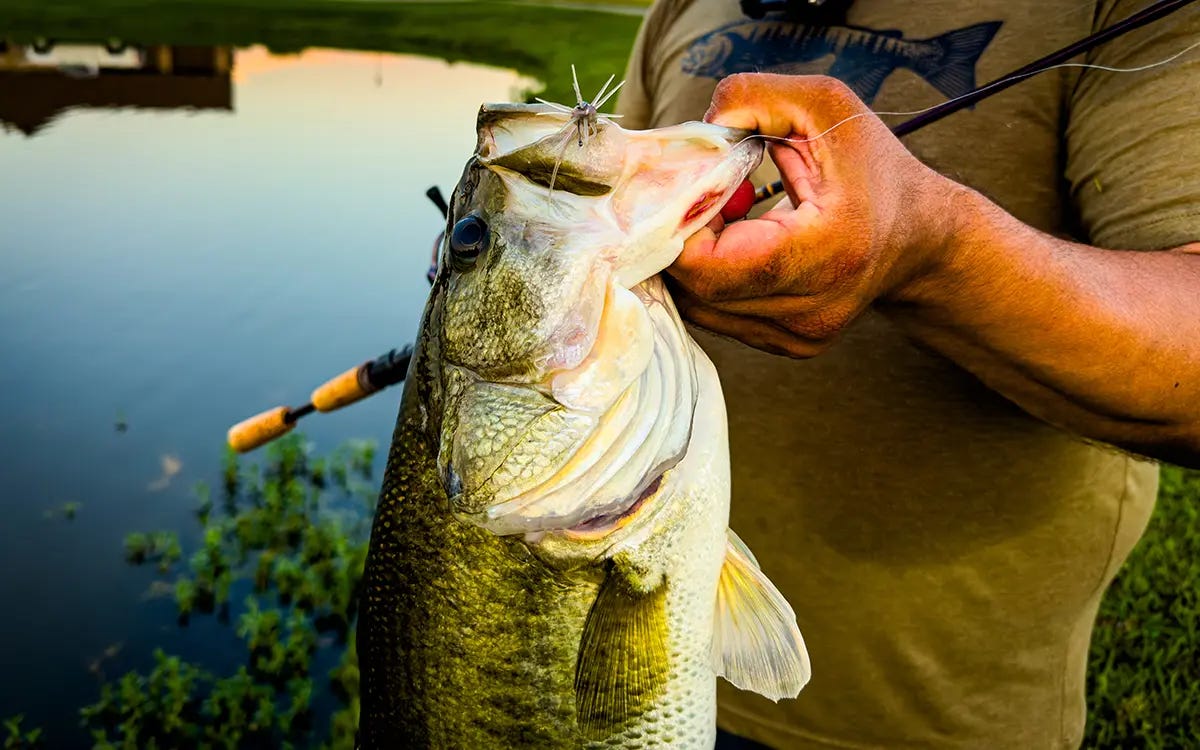
The HideUp Coike has turned bass fishing on its end this year. The last three professional bass fishing tournaments this spring have been won on the Coike or a knockoff version of it. So the market has been flooded with anglers clamoring to get the “hot new cricket” of the minute. But then once they get them, it becomes a scramble to figure out how to rig and fish urchin lures.
But this is one of those trends that seems to have a more lasting staying power, and I will get into that more as we go. But probably the biggest question being asked by anglers who scarfed up a bunch of the knockoffs has to do with rigging and fishing the urchin baits.
How to rig an urchin bait like a Coike
There are about 4,500 videos right now on how to rig the Coike, so I’m not going to try to rehash some version of those. But rather, I want to talk about the nuances of the rigging, especially when you consider what the draw of these lures really are.
A couple considerations here would include how you plan to fish the urchin baits and also making sure you don’t lose your investment on the first fish that bites. Whether you are using a TPE crafted urchin or a simple soft plastic urchin also can factor into how you rig it. I won’t debate the merits of double hooks, treble hooks or single hooks in great detail as much as I will say that the size of the urchin, where you plan to throw it and the material can make one type of hook better than another in different scenarios.
I recommend using some sort of keeper to keep the urchin on whatever hook you choose. Obviously if you choose a double hook or a treble hook, the hook itself is your keeper for the most part. The downside to using the treble hooks and double hooks is your lack of bite, and the fact that the appendages can block the points at times. They are a little more snag-prone than a single hook, especially around wood or grass.
Urchins are unique in that their appendages generally get larger as the get closer to the core so they offer a lot of protection from snags. And they also will keep your bait from fouling in moss on the bottom because the appendages actually stand your bait up off the bottom and keep the hook up away from the snags.
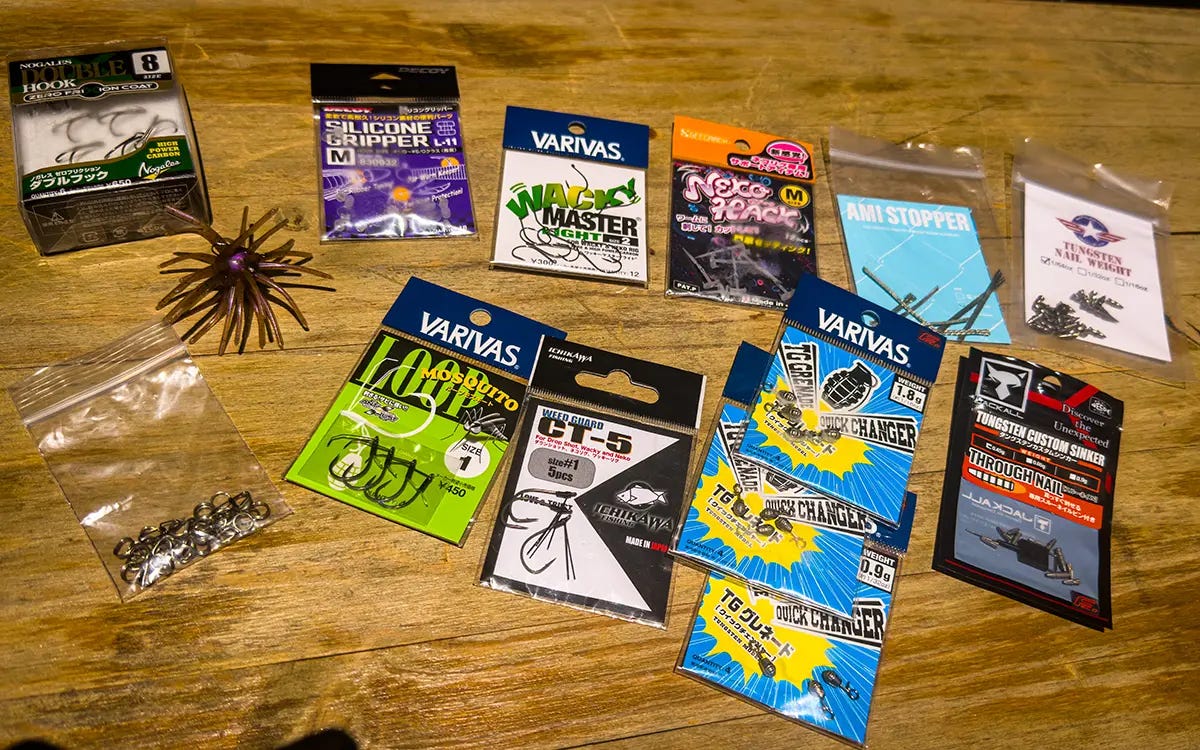
That said, I like a single hook when fishing smaller urchin baits. I prefer a double hook on heavier rigs or when fishing for bigger fish. And part of why I like a double hook is because I use a split-ring hack to add my weight, and it works a little better on a double hook. I saw where Jason Christie opted for a double frog hook when he won the Elite Series in North Carolina. I have been using a hook from Varivas for a few months called a Nogales Double Hook. Ryugi has a nice one too.
I will slide a split ring onto the double hook before pushing the hook through the urchin and then I can clip a weight onto that split ring. That way I can change weights, the weight is in the back for better casting, and I can get a pendulum effect when I fish the bait because I am pulling from the front and the weight is pulling from the bottom. I find it gives the bait an action bass and panfish have loved.
For the hook, I have been using fly hooks specifically scud hooks. You can use a simple drop shot octopus hook or a mosquito hook. I do recommend using either a Neko Hack from Geecrack or a Ami Stopper from HideUp that you can push into the bait, then push your hook through. It will keep the bait from tearing off the hook. The final step is to take little round plastic discs I made using a hole punch on an old Trout Magnet Tungsten jighead package. I just punch out about 50 little discs from that durable but soft plastic packaging. Then, I take and push that clear disc over my hook once I have the urchin rigged, and it will keep the bait from sliding back off the hook that way.
You can rig them on a hook with a nail weight, or add a weight to the eye as a Jika rig. Split ring with a Chebu weights or a free rig works as well. Some guys have put them on jig heads or belly weighted hooks. Fact is you will have to figure out how your fishery sets up. For me the nail weighted and belly weighted with the Chebu weight has provided the best results for where and how I fish. But I don’t discount that there might be better ways for fishing these in different locales and scenarios.
Fishing the Coike and other urchin baits
There are lots of theories circulating around what is making bass go crazy for these things. Guys are talking about the fall and the action of the tentacles and all the like. But I don’t believe what the lure looks like is the draw. I believe the draw is the push of water. And this is also why some knockoffs are not nearly as effective as I have already found.
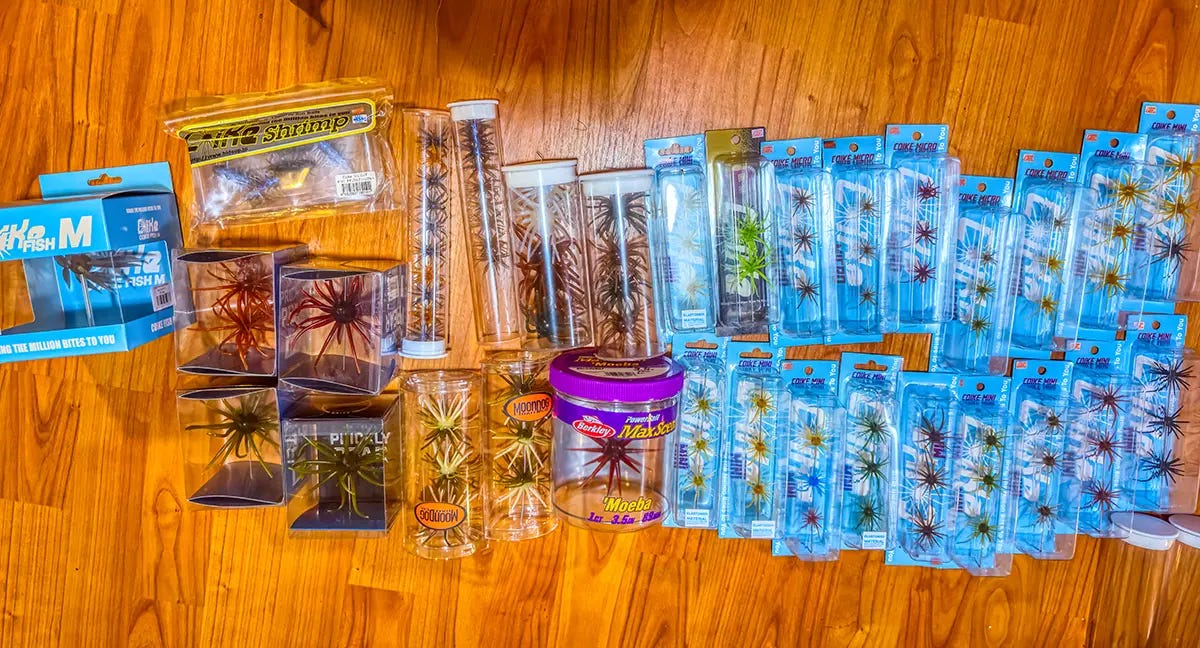
While some of the knockoffs have a lot of movement in the water. The ones that are soft or the tentacles tend to collapse and fold onto themselves, are not any count in my experience. The ones that stay stiffer, push way more water and seem to draw a multiplier of additional bites.
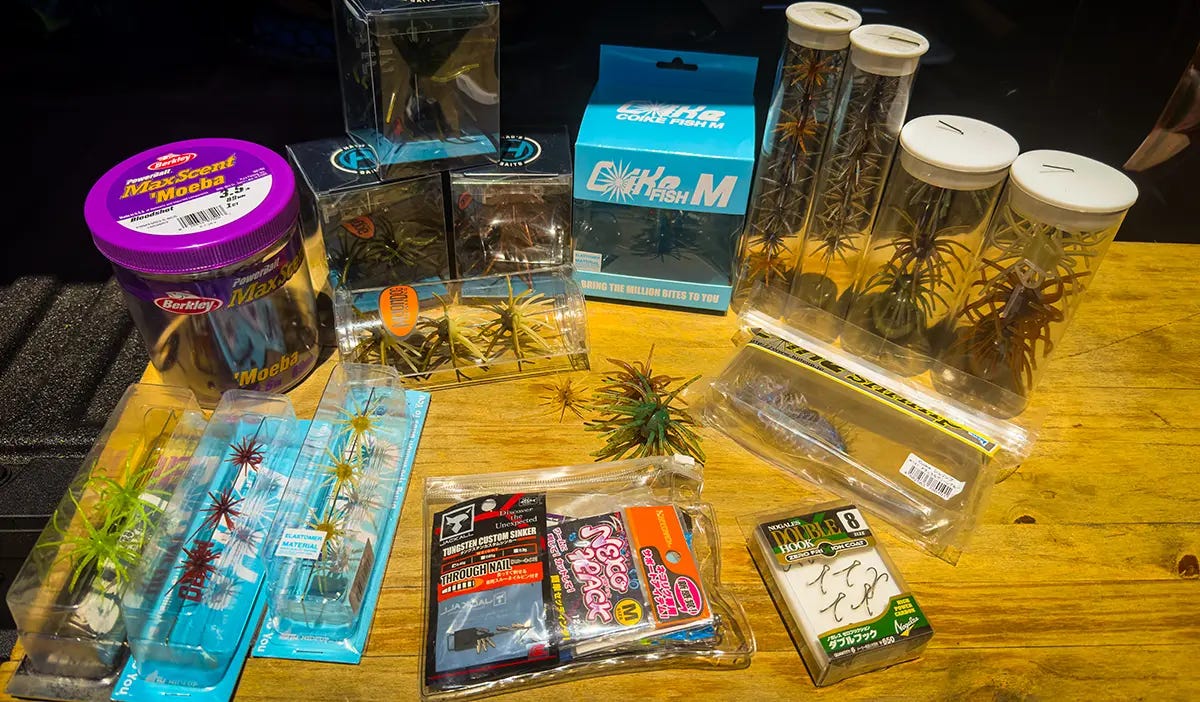
Those stiffer Coikes like the Fullcast are better in my opinion than the Coike M which has more minnow like appendages that fold easily. I think the fish are feeling these baits. I’ve proven it to myself a bunch of times already. Where I see a fish after I have casted the Coike out. And when I move it, I see the fish turn around and get it. It’s like they felt it from behind. I believe they are feeling these baits. I’ve seen it a bunch with panfish as well. I cast the smaller mini bait out and I never move the bait one time. It just sinks until I see my line swimming off.
Almost no other panfish lure, I fish with draws like this thing has this spring.
If I don’t get a bite on the initial cast. I will let it go down and hit bottom and then I will lift up with a hard pull and let it fall again. Usually that’s as far as I get and something has it. I will say I am fishing around targets. I’m not Livescoping with them much. I am casting it around docks, under walkways, next to cover, things like that. A bunch I am just throwing to the edge of bank grass and letting it hit, sink and moving it once or twice and then going again. I feel like if it’s close to a fish, they find it and get it. So I can actually fish really fast with these lures relatively speaking.
I’ve been using lighter weights too. Like a lot of 1/16-ounce and even down to 1/32-ounce on the mini Coikes.
A hard pop can mimic baitfish taking off. So can a hard pull. A subtle lift and drop can work with skittish fish in ultra clear or shallow water. So again this is something you have to play with on your own.
What do the bass think a Coike is?
There has also been much debate on what the bass think these baits are.
I personally believe they don’t actually think these lures are any sort of “creature.” I think they are reacting to a “push” or a “flush” of water. In other words, it’s not what they think they are seeing, but rather what they think they are feeling. I can’t prove this, but I think the way all these appendages push water simultaneously, they think it’s a pod of bait moving or evading. Something they are keenly conditioned to feel and react to.
I believe when they feel that bait push through the water column either on the fall or as you pop it or hop it, they think a small pod of bait is taking off and whirl on it to grab ‘em before they are gone. That’s how a lot of the bites are for me. The bait hits, falls and about half way through the fall the line jumps and is quickly going taught. Or I pull it up hard, and when I start dropping my rod tip, the line is taking off. They whirled on the bait when they “felt” it.
This is again why I think the original Cokie and the ones made a little more rigid but still having good movement on the ends is the critical component that makes the fish react to these baits.
Another thing that sold me on my theory is how many fish I am catching on them after dark. I often go fishing in the evenings because I work all day, so I get on the water from like 5pm until dark. And lately I have been fishing into dark a bit and still getting bit on mini urchins. Like a lot of bites.
So do I think they are seeing this thing in the dark? Maybe. But to me this plays out more like they are “feeling the bait” not seeing the bait.
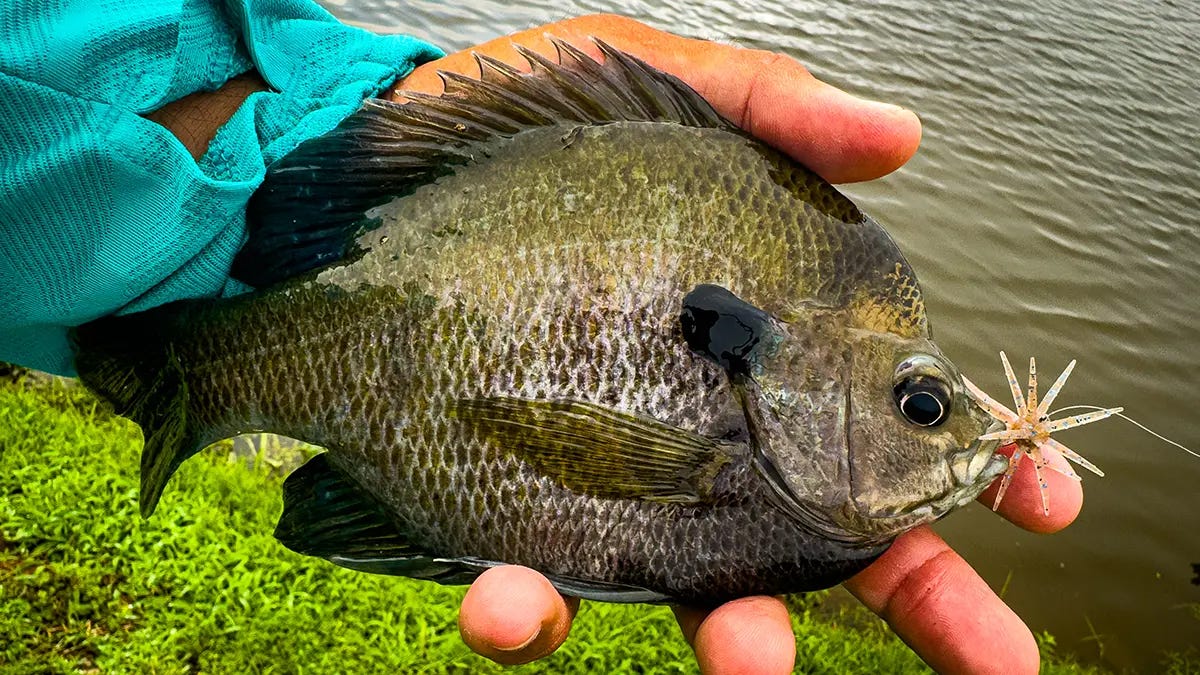
The mini urchins are very effective too
I am a passionate panfish angler. In fact a lot of what I do with this platform is to elevate panfishing because not a lot of in-depth content has been made around things like chasing big red ear all season, or patterning bigger panfish in a variety of ways and locations. So I am also testing theories, working with biologists and other good panfish anglers on panfish tracking, diet sampling, habitat enhancements and more.
So this year, my buddy Will Robey from Cornfield Fishing Gear got me throwing the Mini Coikes for panfish. And I have had a dang ball this spring. My biggest bass this season has also come on a Mini Coike as well, a 7-14 largemouth I caught while panfishing in Arkansas for Coppernose bluegill. And I caught that beast on 2-pound line.
But it is crazy how well it caught panfish for me this spring. Some of my biggest gills came on the Coike Mini this spring including several big red ears. I’ve caught bluegills, Coppernose, green sunfish, hybrid sunfish, red ears, crappie, both black and white and several quality bass on the minis. I think it’s hard to deny the drawing power of these.
At first, I thought the full size ones drew because of their size and the massive push of water. But the small ones must do something similar with panfish. It’s nutty how little you have to work the bait to get bit. At least that was my experience during the spawn. I plan to move offshore with them now and try my hand fishing them deep for panfish. But a nail-weighted Coike Mini has been deadly this spring.
I like the nail weight versions best, although there is not much body to work with on the minis. So you have to add like two small tungsten nail weights usually. My favorites are the Thru Nail Weights from Jackall although they have been hard to find lately.
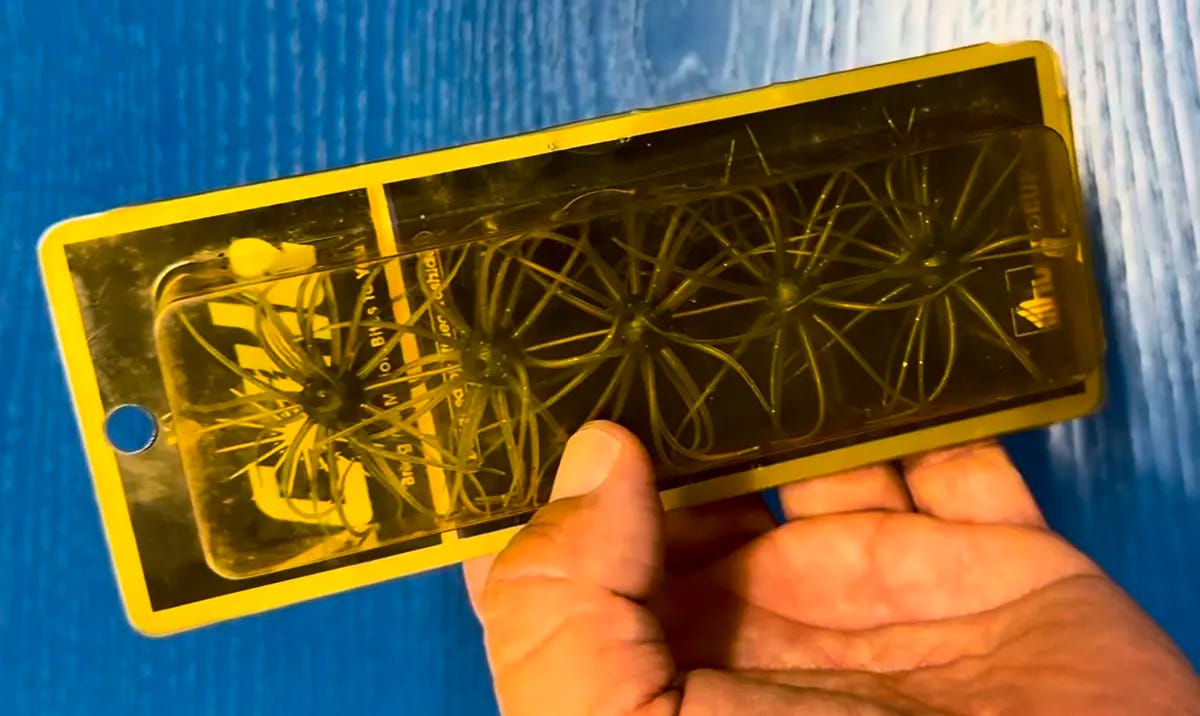
The backstory on the Coike
Everyone has been asking if I have been throwing the new Coike bait this spring. To which I smile wryly before answering, “No. But I’m throwing the old Coike bait.” Because in fact, the Coike has been out for nearly two decades. I actually brought some back from my trip to Japan in 2024 and they sat on my shelf in my tackle room until this spring.
They were originally designed to be topwater buggy baits for highly pressured bass in clear waters. But eventually guys started weighting them and getting them down in the water column and fishing them on different rigs like Jika rigs, neko rigs, free rigs and drop shots. And it was in doing this that anglers stumble upon what I am convinced is this push of water concept.
There have been crazy fads over there years in bass fishing from Alabama Rigs, to dice baits, to Whopper Ploppers, to shaking minnows, and more. But there have also been new things that were all the rage but then have stood the test of time like the Senko. Like the Chatterbait. So we are all anxious to see if this is a new longterm staple or a fad that will fade quickly into small windows and scenarios.
I do believe we are still scratching the surface with these baits, as thus far the tournament wins have been coming in basically the exact same scenario—post spawn bass, still shallow but temperamental. What happens in cold water? What happens in the fall when they are scattered and chasing shad? It still remains to be seen what scenarios fit the draw of these baits. But I know they work around brush piles. So I can see them playing a role as we move into summer brush pile season. So it may be sometime before we know if this is a fad or a new staple. Some are already calling it the new Senko.
It will be interesting to see if the fish become conditioned or if we continue to find new scenarios and ways to present these baits to keep the bites new and fresh. Because it’s been fairly eye opening for me on their drawing power from the Micro to the Max sizes this spring. So I will continue to experiment on my own and report back what I find. And I would love to hear your experiences thus far as well. Feel free to share in the comments to get a discussion going on this explosion of urchin baits and how people are finding to rig, fish and even store them.
Good article Jason.